*** Warning ***
This is not a feel-good, sugar coated post. This is from a deeper place of the heart, but if you know, support, love, correspond with, or are interested in an overseas worker, please, read with a commitment to pray for them more. Again, I am NOT writing these things to garner your sympathy or make you feel pity for us. I just want to offer a perspective on those who've given a portion of their lives to living and working overseas that you may not have thought about like this before.
Thank you for reading!!
**************************************************8
“An overseas worker’s life is one of perpetual grief”, someone once told me. Not the trouble kind of grief like when your dishwasher goes out, or the doctor’s office keeps hounding you for payment, but the heart-wrenching grief that comes with loss- over, and over, and over again. We did not experience this kind of grief-inducing loss the first time until around our 1st year when we went to our first out-of-country conference.
The kids had a wonderful, Spirit-filled week making new friends who “got it”. Ones they could talk for hours with about eating disgusting food with a smile on their faces, who understood what each other was going through in the painful process of learning how to do things all over- learning new rules, new customs, going without the luxuries they’d come from… all that. They laughed together, played in the pool, prayed for each other, sang familiar songs together, and then… cried together when it was time to say good-bye.
It wasn’t the kind of good-bye that comes with a “see you later”; in our world, you never, ever knew if you’d see that someone again. There was always the hope that they (and you) would be back to the next year’s conference, and in between there might be e-mails or a VERY occasional phone call, other than that, the kids were left with a photo or two, memories stored and treasured in their hearts, and a great ache in their soul.
This happened year after year after year. Sometimes Providence would indeed send a few of the same faces, but more often than not, the cycle would start over again; more good-byes, more pain, more scars. These are the things your overseas workers often never talk about. If I were to be brutally honest, I’d have to say that many are too afraid of their supporter’s (or family’s) reactions; sometimes they are an honest assessment, sometimes completely unfounded. Either way, the sad reality is that a lot of the pain never gets talked about outside the “agency family”- these are the things you will likely never hear directly from them.
The topic of “hard work” has so, so many facets- some of it is just plain hard physically, and that’s the easy stuff to adjust to over time. It becomes a new reality and, after a while, doesn’t seem so hard. The vastly harder work of living overseas is seeing your kids suffer the pain of loss, and trying to be a comfort when you’re attempting to deal with that same pain yourself.
With the permission of my older daughters, who are the ones who most acutely feel the sting of loss, I am able to share a bit of our struggles. Sometimes, overseas workers are not even aware of the extent of how deeply their children are affected until their return. I guess for some of us, we don’t recognize the scope of their feelings until the tears flow… sometimes months, and now even a year later- some things are just too painful to lose, or face, or change.
After some discussions lately on what triggers the deep-seated feelings of grief, we’ve identified a few. One is the very real feeling of having “divided” loyalties. They simply don’t feel entirely at home in either world, and at the same time are comfortable in either. Whereas some things they see as detestable in their current “world”, other things that most of their peers see as strange or “weird” is perfectly normal and part of who they are. Of course, as their parents we see a lot of good in this, but they are definitely feeling the pull on their hearsts to have the best of both worlds in their here and now, yet knowing that will never be.
They understand this outsided-ness they deal with day to day, and another thing that brings them sadness is the general lack of interest in a lot of the people around them to want to broaden their worldview. One thing we were warned to do when returning was to prepare a 1 minute, a 3 minute and a 30 minute answer to , “So how was your time over there?” 99% of the people who ask that really don’t care so much about the lives you helped bring change to, nor how it really changed us, so we find ourselves giving the 1 minute answer before the other person moves on to the weather, the latest sitcom, or the NFL scores. Learning about another worldview seems automatically discharged as heathen or “wrong” even if the Word of God gives room for a culture to have other priorities and values than what we currently embrace this week or year. It is frustrating to see such narrow-mindedness and unwillingness to at least entertain the thought that other cultures have some pretty amazing ideas and beautiful traditions.
Perhaps the most painful thing they face is the feeling that some of their good-byes were incomplete. Admittedly, in those last few weeks and days, there was simply not enough time to say farewell individually to each person, place and thing we wanted to. You may find it surprising that “places” are on that list, but it is likely that those beloved places they played in, shared friendships in, or even escaped danger from will likely never be seen again. And as many times as you say goodbye to your childhood pet, it’s just never enough times, is it?
To offer an example, one time a boy of about 13 was asked in a group to tell where he was from. His reply, given with a sarcastic "pffft", "Like you mean, where we were born, or where we're living right now, or where we lived before this....?" Obviously these kids have a real lack of rootedness and will often have wanderlust for their entire adult lives.
A life of grief- I think that’s a pretty accurate term to describe the one overseas workers lead. Of course, the pain will fade over time, but the scars will remain forever. They make us who we are, and we have a story to share made up of all those things we faced for 10 years. And it goes without saying that in that patchwork of our stories a weft of joy, victory, blessing, and perspective. The Lord knows what we store in our hearts and dwells there within!!
Wednesday, August 31, 2011

Sunday, August 21, 2011
The Hard Work of Everyday Life.
So for me, Bekahroo, what was everyday life like while I lived overseas? It was totally different from yours. Mine was more like what you call camping. But I did it 24/7, hence the “everyday”.
For the first 6 years of 10, I didn’t have a bed. I slept Kazakh style, on heavy mats stuffed with raw cotton, which doubled as blankets in the winter. To this day I still prefer a firm bed to a soft one, and I enjoy the floor. I hated the bed I had even after I got it. After three months the nasty piece of junk started stabbing me here and there with wires. Springs sprouted out at the foot of the bed, shredding the sheets. I was glad to leave that item behind.
Another thing that was hard work was my schoolwork. Once I hit high school, Mom could no longer teach me the math and sciences I needed, so she put me on a DVD program, which I really enjoyed. Everything was taught from a Christian view. I loved it. It was peachy keen. Cool. Hip. Until late fall fell. By then the water in the reservoirs up in the mountains were low or out of water. There wasn’t enough electricity to cover the entire city. So the different neighborhoods around the city were put on a strict schedule of two hours on, two hours off. I couldn’t run our DVD machine or TV. I was worried all throughout the autumn and most of the winter about falling behind in my work. This happened with the power every year. How could I keep up year after year?? Would I graduate a year late because of this? The solution ended up being twofold~ When the power was out, I would go up to Dad’s office and use the English center’s DVD machine and TV. That meant walking half a mile with all the books I needed. IF the office had power. The other half of the solution was to slave through the summer. No summer break. 6 months of baking and sweating, sticking to your chair. And trying to study. It’s like something out of a Dickens or Bronte novel. Yeah, Studying wasn’t easy.
Another part of everyday life was how I did my chores. We were OFTEN without our five stars: electricity, or running water, or phone, or internet, or propane with which to cook. A five star day could easily turn into a three star day because of something as simple as a rainstorm. We found out that guests are jinxed. They make you run out of propane when you’re making pizza. But, I have found that the two most valuable of the stars are running water and electricity. They work in tandem to run a washing machine. Without one or the other, it doesn’t work. Without water you flat out cant’ wash your clothing. Without electricity though, you become the washing machine. You’re a robot. Your task is to do the same thing all day long. If it’s summer, you’re outside in 110 or hotter weather. But at least the liquid coming out of the hose is coolish. I found that a pair of jeans feel heavier wet. They don’t ring out so well. They drip on you from the line above you as you’re scrubbing the rest of the clothing. The soap doesn’t dissolve and rubs your ringers raw. Most importantly though, you get used to wearing the same thing for several days.
Another everyday chore that was made difficult was something bazaar, not bizarre- it was “everyday” after all, in the realm of “hard chores”. It was shopping. Shopping here is a treat. Understand, that we had no neat and clean aisles to walk down. We had no air conditioning or heat. We had no anti-odorous meat racks (or whatever they’re called). We had no cars of our own to drive. We had a bazaar we got to visit. Crooked row after crooked row of booths. Each seller had his or her things neatly stacked in bins or tied down to keep them from . There were broken “sidewalks” to walkover as we carried our sacks of produce. Not too easy with 12-15 kilos of food in each arm. In either 110 or -20 degree weather. Buying meat was the worst thing on the list. There were two meat halls. The religiously proper one, and the religiously IMproper one. The first had all it’s meat slaughtered with the animal in question’s head pointed towards Mecca, and blah, blah, blah, it had no pork…. And it stank. Bad. Really bad. The other was essentially the same, but it sold pork, was in a basement, and Russians and Uzbeks instead of Kazakhs sold the meat. All the meat, guts, brains, hooves, and other various edibles are hung up on hooks in a big room. The sellers hack away at ribs and other bones. There’s blood on the floor. There are sheep heads staring eyelessly at you. The corner over there has a cow udder for sale. There are flies everywhere. At least the fish are sold outside. You, as the buyer, are supposed to go into this stinking, slippery-floored slum for your weekly meat. Yup. Everyday.
So yes, everyday was hard. It exhausted me. Did I enjoy it? Absolutely. Would I trade my childhood for one in another country? Absolutely not. It taught me so many things I couldn’t have learned anywhere else. Just today we came close to needing to hand wash our clothing, I wouldn’t have been able to do it if I hadn’t been taught. Being able to shop in a beautiful clean place is a joy. Never running out of propane is a relief! I can cook endlessly! The power only goes out occasionally. Life overseas taught me how to be a better troubleshooter. So much travelling with my family prepared me to travel alone so I could help my grandpa. The life God gave me has put me where I am now, He has given me the friends I have now, and I love them all. I wouldn’t wish myself in a different place in a million years.
So for me, Bekahroo, what was everyday life like while I lived overseas? It was totally different from yours. Mine was more like what you call camping. But I did it 24/7, hence the “everyday”.
For the first 6 years of 10, I didn’t have a bed. I slept Kazakh style, on heavy mats stuffed with raw cotton, which doubled as blankets in the winter. To this day I still prefer a firm bed to a soft one, and I enjoy the floor. I hated the bed I had even after I got it. After three months the nasty piece of junk started stabbing me here and there with wires. Springs sprouted out at the foot of the bed, shredding the sheets. I was glad to leave that item behind.
Another thing that was hard work was my schoolwork. Once I hit high school, Mom could no longer teach me the math and sciences I needed, so she put me on a DVD program, which I really enjoyed. Everything was taught from a Christian view. I loved it. It was peachy keen. Cool. Hip. Until late fall fell. By then the water in the reservoirs up in the mountains were low or out of water. There wasn’t enough electricity to cover the entire city. So the different neighborhoods around the city were put on a strict schedule of two hours on, two hours off. I couldn’t run our DVD machine or TV. I was worried all throughout the autumn and most of the winter about falling behind in my work. This happened with the power every year. How could I keep up year after year?? Would I graduate a year late because of this? The solution ended up being twofold~ When the power was out, I would go up to Dad’s office and use the English center’s DVD machine and TV. That meant walking half a mile with all the books I needed. IF the office had power. The other half of the solution was to slave through the summer. No summer break. 6 months of baking and sweating, sticking to your chair. And trying to study. It’s like something out of a Dickens or Bronte novel. Yeah, Studying wasn’t easy.
Another part of everyday life was how I did my chores. We were OFTEN without our five stars: electricity, or running water, or phone, or internet, or propane with which to cook. A five star day could easily turn into a three star day because of something as simple as a rainstorm. We found out that guests are jinxed. They make you run out of propane when you’re making pizza. But, I have found that the two most valuable of the stars are running water and electricity. They work in tandem to run a washing machine. Without one or the other, it doesn’t work. Without water you flat out cant’ wash your clothing. Without electricity though, you become the washing machine. You’re a robot. Your task is to do the same thing all day long. If it’s summer, you’re outside in 110 or hotter weather. But at least the liquid coming out of the hose is coolish. I found that a pair of jeans feel heavier wet. They don’t ring out so well. They drip on you from the line above you as you’re scrubbing the rest of the clothing. The soap doesn’t dissolve and rubs your ringers raw. Most importantly though, you get used to wearing the same thing for several days.
Another everyday chore that was made difficult was something bazaar, not bizarre- it was “everyday” after all, in the realm of “hard chores”. It was shopping. Shopping here is a treat. Understand, that we had no neat and clean aisles to walk down. We had no air conditioning or heat. We had no anti-odorous meat racks (or whatever they’re called). We had no cars of our own to drive. We had a bazaar we got to visit. Crooked row after crooked row of booths. Each seller had his or her things neatly stacked in bins or tied down to keep them from . There were broken “sidewalks” to walkover as we carried our sacks of produce. Not too easy with 12-15 kilos of food in each arm. In either 110 or -20 degree weather. Buying meat was the worst thing on the list. There were two meat halls. The religiously proper one, and the religiously IMproper one. The first had all it’s meat slaughtered with the animal in question’s head pointed towards Mecca, and blah, blah, blah, it had no pork…. And it stank. Bad. Really bad. The other was essentially the same, but it sold pork, was in a basement, and Russians and Uzbeks instead of Kazakhs sold the meat. All the meat, guts, brains, hooves, and other various edibles are hung up on hooks in a big room. The sellers hack away at ribs and other bones. There’s blood on the floor. There are sheep heads staring eyelessly at you. The corner over there has a cow udder for sale. There are flies everywhere. At least the fish are sold outside. You, as the buyer, are supposed to go into this stinking, slippery-floored slum for your weekly meat. Yup. Everyday.
So yes, everyday was hard. It exhausted me. Did I enjoy it? Absolutely. Would I trade my childhood for one in another country? Absolutely not. It taught me so many things I couldn’t have learned anywhere else. Just today we came close to needing to hand wash our clothing, I wouldn’t have been able to do it if I hadn’t been taught. Being able to shop in a beautiful clean place is a joy. Never running out of propane is a relief! I can cook endlessly! The power only goes out occasionally. Life overseas taught me how to be a better troubleshooter. So much travelling with my family prepared me to travel alone so I could help my grandpa. The life God gave me has put me where I am now, He has given me the friends I have now, and I love them all. I wouldn’t wish myself in a different place in a million years.
Monday, August 15, 2011
The "Hard Work" of Living in a Developing Country- Pt. 6
As I look back on the various tolls living overseas exacted on body and soul, it might be good to take a brief glimpse into the heavy wages paid in terms of “items lost”. Physical trinkets may immediately come to mind, but there is such a variety of other, more costly effects, that were so much more precious to be lost.
The first thing one must give up when living abroad is his sense of control. That goes out the window in about the first 3 hours of landing. Control over how fast your taxi will drive you into town, and whether or not he will have chosen beer or vodka as his liquor of choice; control over having the washing machine of your choice- heck, even having one at all for the first month might be an enormous luxury; control over whether your children will have vaccinations, enough fresh fruits and vegetables to eat (for the first 3 winters, we ate ONLY carrots, onions, potatoes and cabbage for 5 months straight) or enough children’s Tylenol when the fevers got too high. If you think control over who was listening to your phone, who was watching you outside your window, or who was following you onto the train for a ride across the country, forget it. They controlled all of that. One area of control that was particularly hard to endure was control over censoring information that might make loved ones (especially parents/grandparents) overly concerned or worried. News media can paint a frightening picture of the real stories and, on the other hand, it’s hard to make the kids, especially if they are young, understand that not everyone needs to hear everything.
We were told very clearly to “count the costs” by many trusted and close friends before we left, but some things just can’t be anticipated, nor can one even begin to imagine all that could be demanded living away from home, culture, family, friends, and personal, treasured things and comforts. Not only is that ever-elusive “control” lost, but one’s sense of belonging is quickly snatched away, only to be bought back through hard work, rivers of tears, and an over-abundance of embarrassing mistakes and misunderstandings. Gone within minutes of landing is that safe, comfortable sense of “place” and security. When one is rooted in a certain set of “rules” and standard of behavior, it is nearly impossible on every level to find a new norm and be completely at home in it. Daily we struggled with everything from the simple ‘How do I talk on a bus (in our cases not at all)?’ and ‘How should my legs be tucked under me while sitting on the floor at someone’s dinner table?’, to the more complicated like, ‘What would be appropriate to say to my neighbor at a public wake who has just been widowed?’ and ‘What do I do when my neighbor comes to the door holding her child who is literally dying in her arms?!’
How can one “count the cost” when neither a pregnancy nor a revolution in the neighboring country had been anticipated? How can one come back to a country that has gone through its own crisis? Our family has almost no common or shared emotional connection to the rest of America who has witnessed 9/11 ; we saw none of the images, spoke to no one during that time, and only read the headlines weeks later in a borrowed magazine. While we were struggling to make a new normal, we utterly missed an entire decade of the “other” that made America a completely different place to come back to. We suffered the hard work of trying to relate to those who’d call and try to communicate the changes, but just could not. Another “item lost”…
It may be strange to say, or rather maybe even hard to believe, but I, in my heart of hearts, think our bodies took a much greater physical toll than if we’d lived here for the same 10 years. I won’t go into the litany of issues for fear of sounding like a whiner, but summer sun, heavy bags to and from the bazaar, the stress of everyday living, various falls on ice, constant stomach issues, and lack of nutritious food all add up to less healthy people. That was one cost we counted, and I have nothing to grumble about. It’s a reality we live with, and we count it as gain.
There were, of course, those “physical trinkets” we had to say good-bye to for a season. Some, over time, lost their meaning or dearness; others we yearned for year after year. Christmas was an especially melancholy time as almost every tradition was left behind. Dinners with extended family were impossible, fabulous meals with all the trimmings were suddenly gone, beloved decorations that held special meaning were not there. Instead was a 4 foot plastic tree that fell apart more and more every year, candy garlands hung on the tree in a lame attempt to make things colorful, and we listened to the same music over and over and over on the only 2 CDs of Christmas music we had. Of course, not all was lost. We eventually made friends and had Christmas dinner with them and our teammates. Care packages full of goodies arrived once in a while full of nice gifts like peanut butter and silk flowers, and we learned to make our own music to fill the gap.
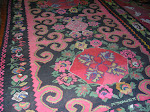
At first everything was new and exciting and we didn’t miss our “stuff”. But as time went on, our home began to feel bare and Spartan. We really longed for a few familiar things to remind us of where we’d come from. Unlike a lot of other host countries, ours had really no beautiful arts or crafts to offer in order to make a home inviting other than rugs. Ours was a country that had only recently gotten their independence, and had not been open to free market trading for very long. The only goods that regularly came in were low quality and purely functional- not meant for making a house a home. I longed for pictures on the walls of my loved ones, vases of fresh flowers, even just a simple throw pillow to brighten up our floor (we didn’t have a couch and chairs until well into our 3rd year). I never thought I’d be one to dwell on “stuff”, but I found myself missing those boxes packed away, hoping that they were safe until the day we could see it again.
Continued Next Time….
The first thing one must give up when living abroad is his sense of control. That goes out the window in about the first 3 hours of landing. Control over how fast your taxi will drive you into town, and whether or not he will have chosen beer or vodka as his liquor of choice; control over having the washing machine of your choice- heck, even having one at all for the first month might be an enormous luxury; control over whether your children will have vaccinations, enough fresh fruits and vegetables to eat (for the first 3 winters, we ate ONLY carrots, onions, potatoes and cabbage for 5 months straight) or enough children’s Tylenol when the fevers got too high. If you think control over who was listening to your phone, who was watching you outside your window, or who was following you onto the train for a ride across the country, forget it. They controlled all of that. One area of control that was particularly hard to endure was control over censoring information that might make loved ones (especially parents/grandparents) overly concerned or worried. News media can paint a frightening picture of the real stories and, on the other hand, it’s hard to make the kids, especially if they are young, understand that not everyone needs to hear everything.
We were told very clearly to “count the costs” by many trusted and close friends before we left, but some things just can’t be anticipated, nor can one even begin to imagine all that could be demanded living away from home, culture, family, friends, and personal, treasured things and comforts. Not only is that ever-elusive “control” lost, but one’s sense of belonging is quickly snatched away, only to be bought back through hard work, rivers of tears, and an over-abundance of embarrassing mistakes and misunderstandings. Gone within minutes of landing is that safe, comfortable sense of “place” and security. When one is rooted in a certain set of “rules” and standard of behavior, it is nearly impossible on every level to find a new norm and be completely at home in it. Daily we struggled with everything from the simple ‘How do I talk on a bus (in our cases not at all)?’ and ‘How should my legs be tucked under me while sitting on the floor at someone’s dinner table?’, to the more complicated like, ‘What would be appropriate to say to my neighbor at a public wake who has just been widowed?’ and ‘What do I do when my neighbor comes to the door holding her child who is literally dying in her arms?!’
How can one “count the cost” when neither a pregnancy nor a revolution in the neighboring country had been anticipated? How can one come back to a country that has gone through its own crisis? Our family has almost no common or shared emotional connection to the rest of America who has witnessed 9/11 ; we saw none of the images, spoke to no one during that time, and only read the headlines weeks later in a borrowed magazine. While we were struggling to make a new normal, we utterly missed an entire decade of the “other” that made America a completely different place to come back to. We suffered the hard work of trying to relate to those who’d call and try to communicate the changes, but just could not. Another “item lost”…
It may be strange to say, or rather maybe even hard to believe, but I, in my heart of hearts, think our bodies took a much greater physical toll than if we’d lived here for the same 10 years. I won’t go into the litany of issues for fear of sounding like a whiner, but summer sun, heavy bags to and from the bazaar, the stress of everyday living, various falls on ice, constant stomach issues, and lack of nutritious food all add up to less healthy people. That was one cost we counted, and I have nothing to grumble about. It’s a reality we live with, and we count it as gain.
There were, of course, those “physical trinkets” we had to say good-bye to for a season. Some, over time, lost their meaning or dearness; others we yearned for year after year. Christmas was an especially melancholy time as almost every tradition was left behind. Dinners with extended family were impossible, fabulous meals with all the trimmings were suddenly gone, beloved decorations that held special meaning were not there. Instead was a 4 foot plastic tree that fell apart more and more every year, candy garlands hung on the tree in a lame attempt to make things colorful, and we listened to the same music over and over and over on the only 2 CDs of Christmas music we had. Of course, not all was lost. We eventually made friends and had Christmas dinner with them and our teammates. Care packages full of goodies arrived once in a while full of nice gifts like peanut butter and silk flowers, and we learned to make our own music to fill the gap.
At first everything was new and exciting and we didn’t miss our “stuff”. But as time went on, our home began to feel bare and Spartan. We really longed for a few familiar things to remind us of where we’d come from. Unlike a lot of other host countries, ours had really no beautiful arts or crafts to offer in order to make a home inviting other than rugs. Ours was a country that had only recently gotten their independence, and had not been open to free market trading for very long. The only goods that regularly came in were low quality and purely functional- not meant for making a house a home. I longed for pictures on the walls of my loved ones, vases of fresh flowers, even just a simple throw pillow to brighten up our floor (we didn’t have a couch and chairs until well into our 3rd year). I never thought I’d be one to dwell on “stuff”, but I found myself missing those boxes packed away, hoping that they were safe until the day we could see it again.
Continued Next Time….
Subscribe to:
Posts (Atom)